Tattoo pens & tattoo equipment
Tattoo pens made for other brands use precision-machined aluminum bodies with an anodized finish.
What we made外壳加工 / 整机?
OEM · ODM · Private label
Have a product idea, a drawing, or a product you want under your own name? We design, machine, assemble, test and pack it in our factory in Dongguan, China — from the first prototype to boxed products ready to sell.
Machined parts come together into one grinder
Pick your model
OEM vs ODM vs private label: OEM (original equipment manufacturing) means you supply the design and Dayao builds it to your drawings. ODM (original design manufacturing) means Dayao’s engineers design the product from your idea, then build it. Private label means Dayao puts your logo and packaging on a model it already makes. Choose OEM when your drawings are finished, ODM when you only have an idea, and private label when speed and low upfront cost matter most.
| Question | OEMBuild to your design | ODMWe design it with you | Private labelOur model, your brand |
|---|---|---|---|
| Who designs the product? | With OEM, the brand designs the product and sends 3D files, drawings and specs. | With ODM, the factory’s engineers design the product from the brand’s idea, sketch or reference product. | With private label, nothing new is designed — the brand picks one of the factory’s existing models. |
| Upfront cost | OEM upfront cost is the highest: new tooling and sample rounds for a brand-new design. | ODM upfront cost is medium: design work, tooling and samples. | Private label upfront cost is the lowest: only the logo, color and packaging change. |
| Time to market | OEM is usually the slowest route, because a new design needs new tooling and several sample rounds. | ODM usually sits in the middle; speed depends on how much existing design can be reused. | Private label is the fastest route, because the product and its tooling already exist. |
| Exclusive to your brand? | An OEM product is made only for your brand, because it is built to your design. | An ODM product is sold only to you when exclusivity is written into the contract. | A private label base model is not exclusive — other brands may sell the same model. |
| What you send | For OEM, send 3D files, 2D drawings, specs and your target cost. | For ODM, send an idea, sketch, photos or a product to improve, plus target price and quantity. | For private label, send your logo, colors and packaging wishes. |
| Best for | OEM suits brands that have their own design or engineering team. | ODM suits brands with a product idea but no engineers. | Private label suits brands testing a market or adding a product fast. |
Source: OEM, ODM, private label and white label are general industry terms, not formal standards; Dayao services from Dayao factory data (2026).
Idea to shelf
To manufacture a product with Dayao, a brand passes eight approval gates: brief and NDA, design, prototype, engineering samples (EVT/DVT), golden sample sign-off, pilot run (PVT), mass production, and packing and shipping. Nothing moves to the next gate until the brand approves it. Timing depends on the product and its tooling, so Dayao confirms the schedule in each quote instead of promising a fixed lead time.
You tell Dayao what the product must do, who it is for, the target price and the quantity. You can share drawings, a sketch or a product you want to improve. An NDA can be signed before you send any files.
You approveThe brief: features, target cost, quantity
For ODM, Dayao engineers design the structure, choose materials and plan how each part is made. For OEM, an engineer reviews your design for manufacturing (DFM) and points out cost and quality risks before tooling is made.
You approveDesign freeze: 3D model, materials, bill of materials, cost estimate
The first working units are built, with key parts CNC machined so the design can still change cheaply. You test how the prototype looks, feels and works.
You approveLook, feel and function of the prototype
Molds and fixtures are made, and samples come off the real production tooling. EVT (engineering validation test) checks that the engineering works; DVT (design validation test) checks the full design. For a grinder that means grind consistency, burr alignment, wear and drop tests.
You approveTest results and any final changes
You sign the approved golden sample, the reference unit for your product. One sealed golden sample stays with you and one with Dayao, and production batches are checked against it.
You approveThe golden sample — your quality standard
A small pilot batch runs on the production line, with real assembly, testing and packaging. The PVT (production validation test) run proves the line, not just the product.
You approvePilot units, packaging and test reports
Mass production runs with three quality checks: IQC on incoming parts, IPQC during production and OQC on finished units before they are packed.
You approveFinal inspection before shipping (yours or a third party)
Products go into retail boxes and export cartons with shipping marks, then ship on the term you choose: FOB, EXW, CIF or DDP (Incoterms 2020).
You approvePacking list and shipping documents
Source: EVT (engineering validation test), DVT (design validation test) and PVT (production validation test) are common hardware-industry stage names, not a formal standard; FOB, EXW, CIF and DDP per Incoterms® 2020 (International Chamber of Commerce); gate process from Dayao factory data (2026).
Flagship product
A hand coffee grinder’s grind quality depends mostly on five parts: burr material, burr design (5-, 6- or 7-star), shaft bearings, grind adjustment and body. Dayao builds household, commercial and industrial hand grinders under your brand, and its grinder line assembles 2,000 units a day. Pick each part below; the spec sheet fills in as you go and can be sent with your quote request.
Source: Dayao factory data (2026) — grinder line capacity 2,000 units a day; burr, bearing and adjustment notes from Dayao’s hand coffee grinder OEM guide on dayaotek.com.
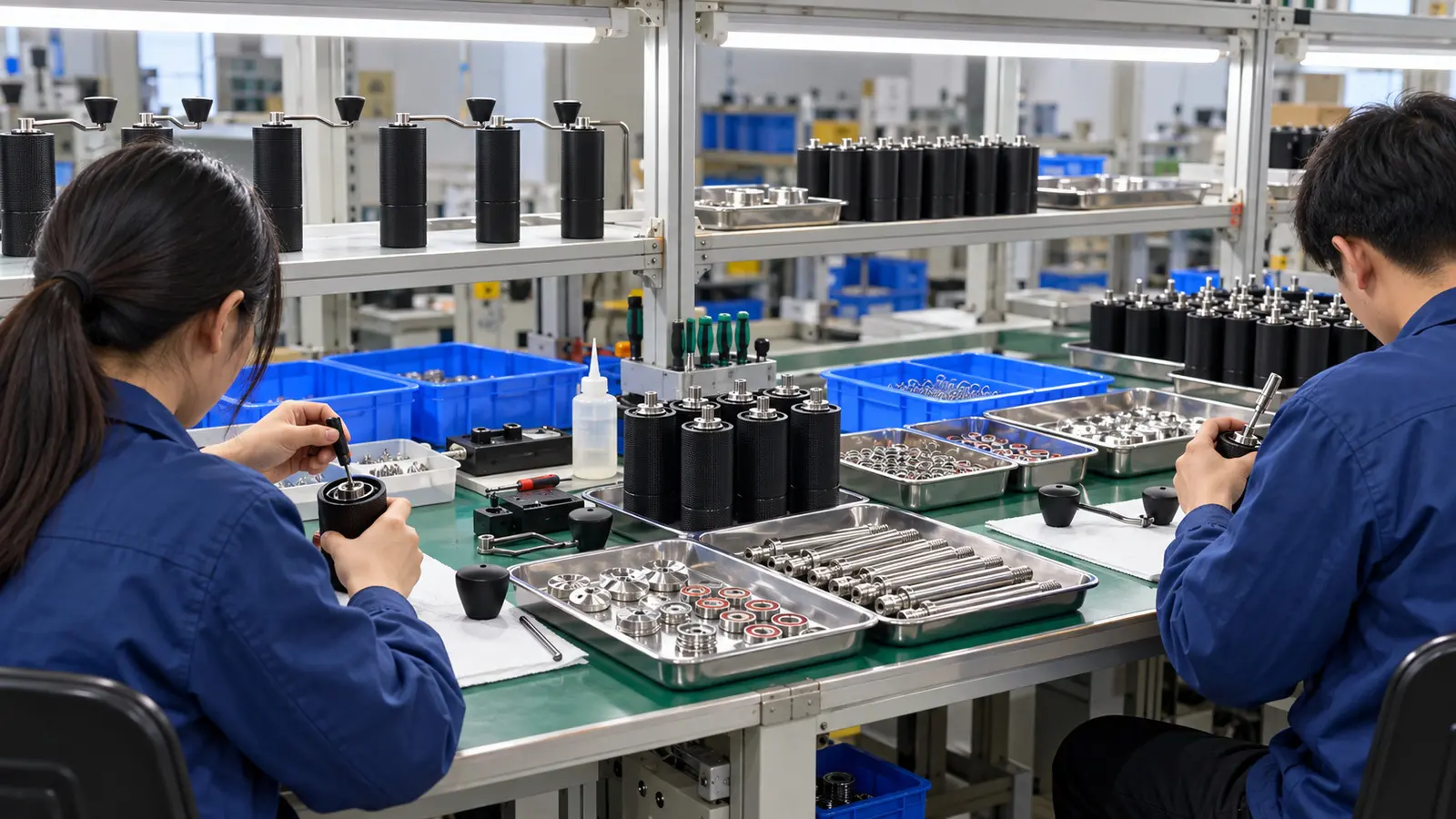 待放图磨豆机装配线实拍(多人工位 + 成品)
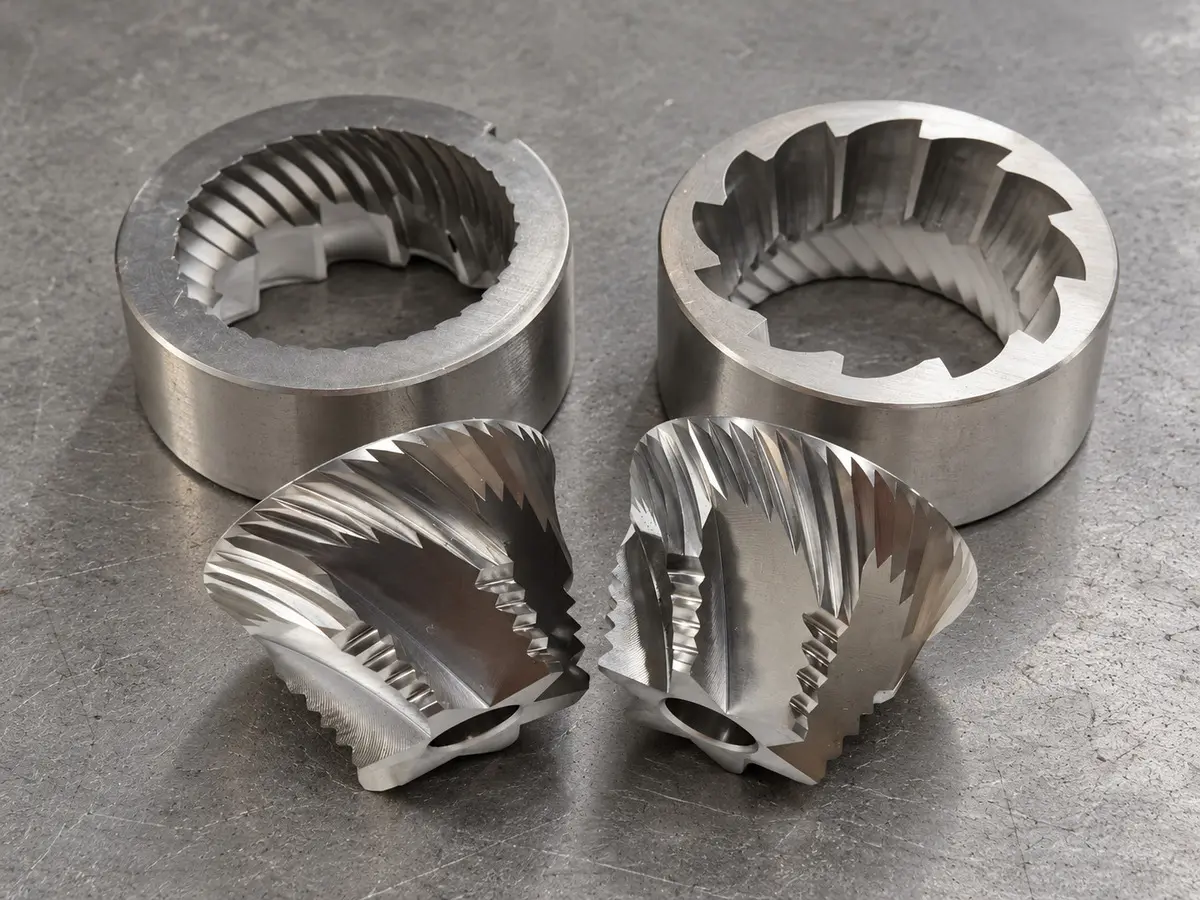 待放图不同材料 / 星型的刀盘并排
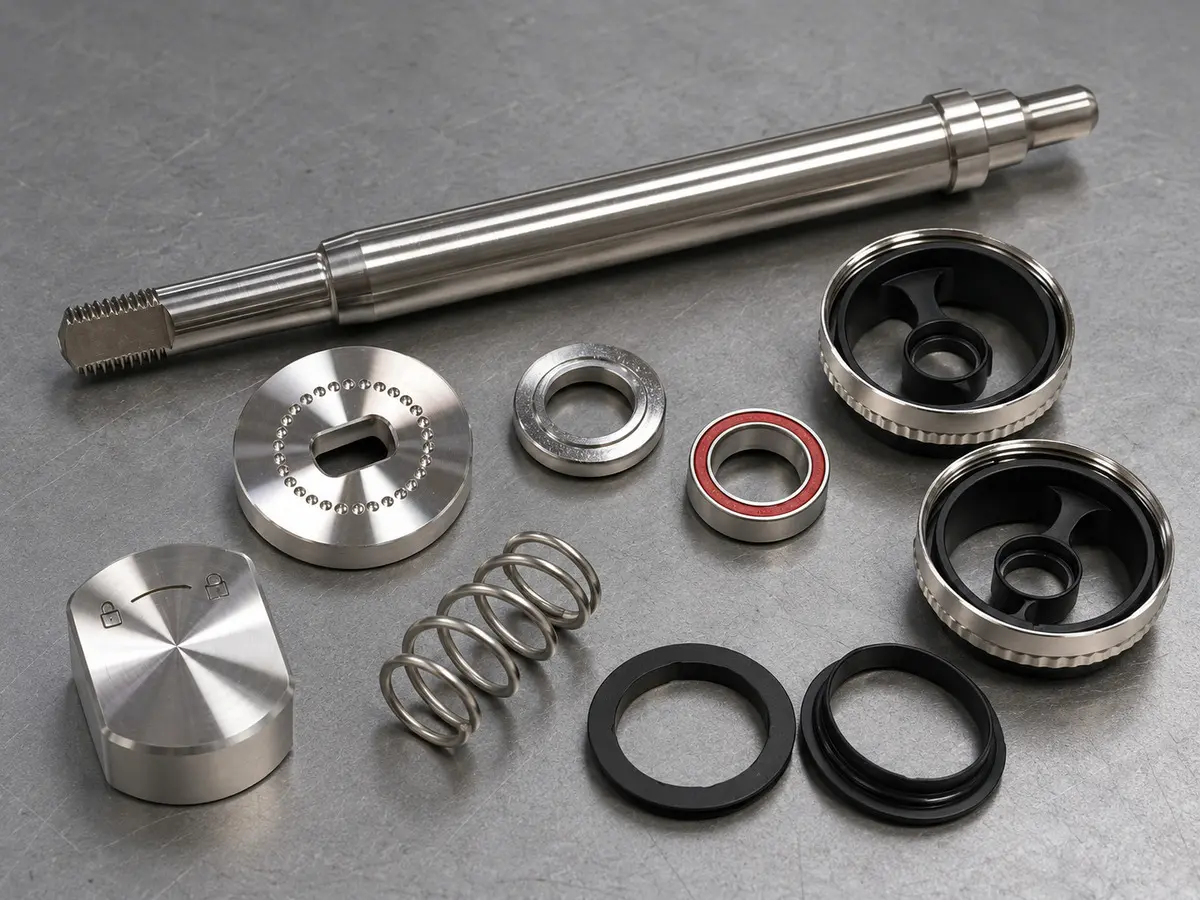 待放图中心轴 / 调节内圈 / 压圈(官网已有图)
Made for other brands
Besides hand coffee grinders, Dayao has made products for other brands in five categories: tattoo pens and tattoo equipment, pet clippers, hair removal devices, humidifiers and GPS trackers. Brand names stay private, so the shelf below shows product categories only. If your product is similar to one of these categories, mention it in your brief so an engineer can compare it with past work.
Tattoo pens made for other brands use precision-machined aluminum bodies with an anodized finish.
What we made外壳加工 / 整机?
Pet clippers are handheld grooming tools whose housings and blade parts must fit closely.
What we made外壳加工 / 整机?
Hair removal devices are handheld beauty products with a housing built around the electronics.
What we made外壳加工 / 整机?
Humidifiers are home appliances with parts that stay in contact with water every day.
What we made外壳加工 / 整机?
GPS trackers are small electronic devices that need compact, closely fitting housings.
What we made外壳加工 / 整机?
Source: product categories from Dayao’s article “Want To Create Your Own Brand But Don’t Have A Factory?” on dayaotek.com; Dayao factory data (2026).
How far we take it
Box build assembly means the factory assembles the complete product, not just the parts. Dayao offers five delivery levels: parts, sub-assemblies, box build and final assembly, retail-ready packing, and packed and shipped. The top level is turnkey manufacturing, where Dayao handles everything from parts to shipping. Choose a lower level when you run your own assembly line, and a higher level when you want products ready to sell.
Level 1 delivers CNC machined and sheet metal parts made to your drawings, from a single prototype to production runs.
ThenYou assemble them yourself.
Level 2 delivers sub-assemblies: bearings pressed in, threads and hardware fitted, and modules put together and checked.
ThenYou do the final assembly.
Level 3 is box build: the complete product is assembled, adjusted and checked at OQC — for a grinder, the burr gap is set.
ThenYou add packaging.
Level 4 adds your logo on the product, your color box, inserts, manual and barcode labels — ready for a shelf or a warehouse.
ThenReady to sell.
Level 5 is turnkey: export cartons with shipping marks and packing lists, shipped on FOB, EXW, CIF or DDP terms (Incoterms 2020).
ThenDelivered to your door or port.
Source: Dayao factory data (2026); shipping terms per Incoterms® 2020 (International Chamber of Commerce).
Confidentiality
Dayao can sign an NDA (non-disclosure agreement) before you send any drawings, samples or product ideas. An NDA is a contract in which the receiving company agrees not to share your confidential information or use it for anything except your project. Ask for an NDA in your first message, or tick the NDA box on the quote form, and send files only after both sides have signed.
Source: Dayao factory data (2026). The checklist is general buyer guidance, not legal advice.
Dayao can sign a non-disclosure agreement (NDA) before you send drawings, 3D models, samples or product ideas.
A typical manufacturing NDA lists what is confidential — drawings, models, samples, prices and product plans — and how each may be used.
A useful NDA names both companies, defines the confidential information, states how long the duty lasts and which law applies.
An NDA covers confidentiality only; exclusivity and other commercial terms belong in your order contract, agreed term by term.
Questions
These are the questions brands ask most before an OEM or ODM project: how OEM, ODM, private label and white label differ, what EVT, DVT, PVT and a golden sample are, how to find a manufacturer, minimum order quantity and hand coffee grinder options. Dayao, a factory in Dongguan, China founded in 2014, builds your design (OEM), designs it with you (ODM) or brands an existing model (private label).
With OEM (original equipment manufacturing), the brand supplies the design and the factory builds the product to those drawings. With ODM (original design manufacturing), the factory designs the product from the brand’s idea or brief, and exclusivity is agreed in the contract. OEM asks more design work from the brand but gives full control of the design; ODM is faster and cheaper to start.
Apple designs its own products and hires contract manufacturers to build them. So Apple is the brand, and its factories work on an OEM basis — they build Apple’s design. A brand that sends Dayao its own drawings uses the same OEM set-up, at a much smaller scale.
Private label manufacturing means a factory makes one of its existing products and puts your brand on it — your logo, color and packaging. It is the fastest and cheapest way to launch a product, but the base design is not exclusive to you.
White label is a generic product sold to many brands with almost no changes. Private label is made for one brand, with that brand’s logo, packaging and often small changes such as color or materials.
EVT, DVT and PVT are the three common test stages between prototype and mass production in hardware. EVT (engineering validation test) checks that the engineering works; DVT (design validation test) checks the full design on production tooling; PVT (production validation test) checks that the production line can build it at the agreed quality. They are industry terms, not a formal standard.
Yes — building a product from an idea or sketch is ODM. Share what the product must do, your target price and quantity, and any sketch or reference product. Dayao engineers turn it into a design you approve before any tooling is made, and an NDA can be signed first.
The minimum order quantity for an OEM or ODM product depends on the product and how much new tooling it needs. Private label orders on existing models usually start lower than fully new designs. Machined and sheet metal parts have no fixed minimum. 各模式起订量待核实
A golden sample is the approved production unit that the brand signs before mass production; it becomes the quality reference for every batch. At Dayao, one sealed golden sample stays with the brand and one stays with the factory.
To find a manufacturer, look for proof that the factory has made similar products, ask for samples before production, sign an NDA, get an itemized quote that separates tooling from unit price, and see the factory in person or on a video call. Our factory page explains how to verify a factory in China.
Yes. Dayao makes household, commercial and industrial hand coffee grinders, with a choice of burr material, burr design, bearings and adjustment, and the grinder line assembles 2,000 units a day. Use the grinder spec builder above to start your brief.
With the same burr design, ceramic, stainless, high-nitrogen and high-carbon steel burrs grind very similarly at first. Differences show over long use: ceramic never rusts, high-nitrogen steel stays sharp longest, and high-carbon steel is very sharp but must stay dry.
Yes. If you only need machined or sheet metal parts made to your drawings, see our CNC machining services and sheet metal fabrication.
Reviewed by the Dayao engineering team · Updated October 2026
To start an OEM or ODM project with Dayao, send a sketch, a reference product, a drawing or a few lines about what the product must do — any one of these is enough. An engineer reviews it and replies with questions, a plan and an itemized quote. An NDA can be signed before you share anything.