Three linear axes (X, Y, Z)
X and Y move the tool across the part and Z moves it up and down, exactly as on a 3-axis milling machine.
Dayao machines complex metal and plastic parts on 5-axis machining centers in its own factory in Dongguan, China. Five faces and angled features are cut in one setup, held to ±0.01 mm as standard and ±0.005 mm on critical features, and checked on a CMM — from one prototype to production.
A 0° · C 0°
The part stays clamped; the table tilts (A) and turns (C).
5-axis CNC machining moves the cutting tool along three straight axes, X, Y and Z, while two rotary axes tilt and turn the part or the spindle. Under ISO 841, the rotary axes are named A, B and C, for rotation around X, Y and Z. The result is that one machine reaches five faces of a part, and angled features, without re-clamping it.
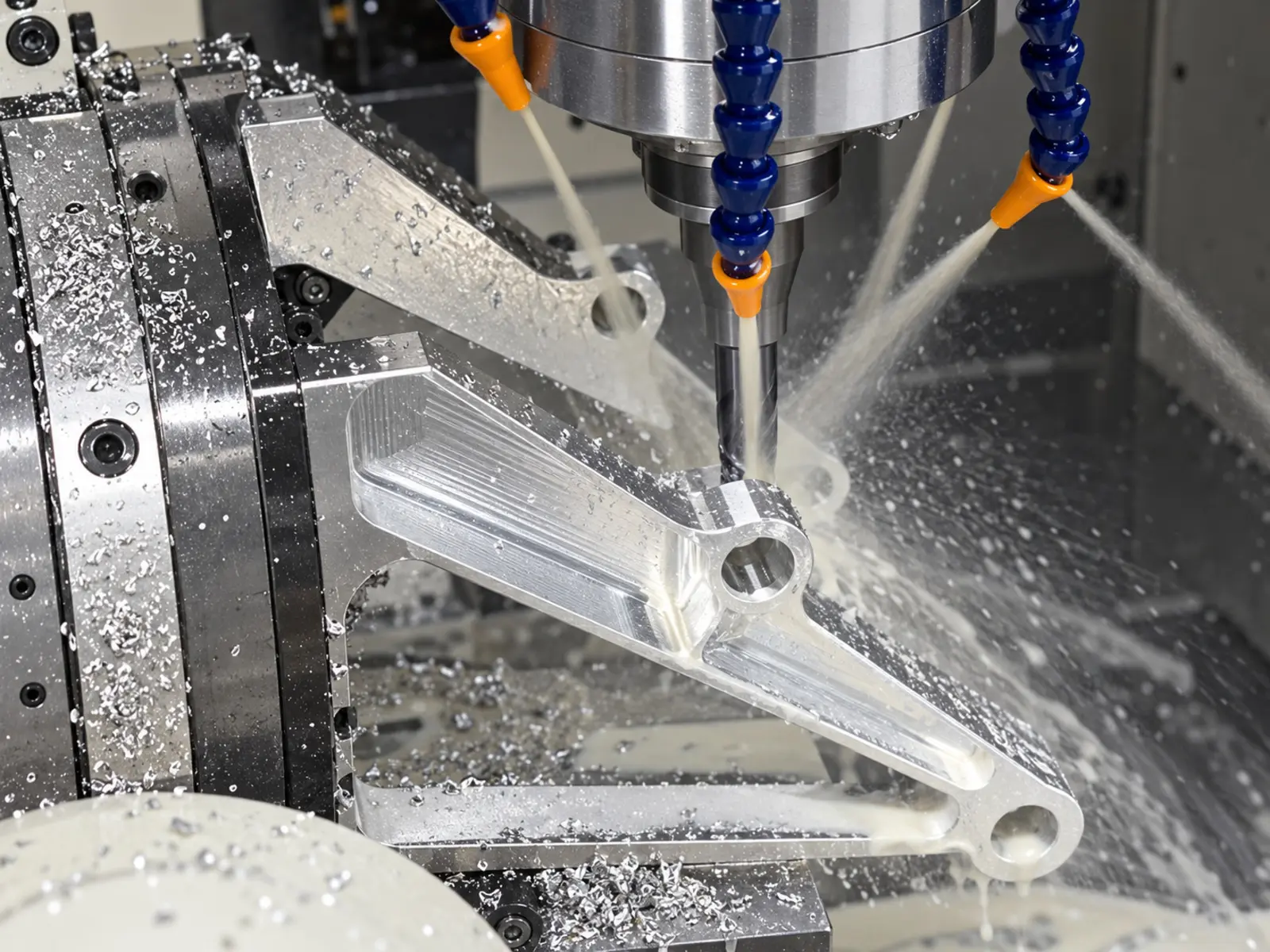
X and Y move the tool across the part and Z moves it up and down, exactly as on a 3-axis milling machine.
One rotary axis tilts the part or the head (A or B) and the other turns it around the vertical (C), so any face can point at the tool.
| Machine layout | How it moves | Best for | Limit |
|---|---|---|---|
| Trunnion (table-table) | Both rotary axes are in the table: it tilts (A or B) and turns (C) while the spindle stays upright. | Small to mid-size parts, deep undercuts, heavy cutting with a rigid spindle | Part size is limited by the space between the trunnion supports |
| Swivel head (head-head) | The spindle head tilts and rotates while the table stays still, so the part never moves. | Large and heavy parts, long parts, molds | Some travel is used up by the tilting head; less reach under overhangs |
| Head-table | The head tilts on one axis and the table turns on the other. | Mid-size parts, multi-vise and plate work | A middle ground between the two |
Source: ISO 841:2001 (axis nomenclature); Hurco, “5-axis CNC machine configurations: the pros and cons” (machine layouts); Dayao factory data (2026).
You need 5-axis when a part has features on three or more faces that must line up, holes or faces at compound angles, undercuts or deep pockets that need a short tool, or curved surfaces the tool must follow. If the features sit on one or two faces, 3-axis milling is cheaper. A Dayao engineer makes this call from your drawing before quoting, and suggests the cheaper route when it works.
If holes, pockets or threads sit on three or more sides and must line up with each other, one 5-axis setup avoids re-clamping between faces.
A hole or face tilted in two directions at once is reached directly on 5-axis; on 3-axis it needs an angled fixture made for that one part.
Tilting the part lets a shorter tool reach under a lip or into a deep pocket, which cuts with less chatter than a long tool.
Impeller blades, ergonomic grips and blended surfaces need the tool to follow the surface continuously — that is simultaneous 5-axis work.
When a feature on one face is toleranced to a datum on another face, keeping both in one clamping removes re-clamping error.
A flat plate or block with features on one or two faces is cheaper on 3-axis; 5-axis machine time costs more per hour.
How many faces have holes, pockets or threads?
Are any holes or faces at a compound angle, or under an overhang?
Must features on different faces line up tightly?
Source: common machining practice for choosing 3-axis, 3+2 and 5-axis routes; Dayao engineering review practice (2026). The tool above is a guide, not a quote.
Most 5-axis work is 3+2, also called positional 5-axis: the rotary axes turn the part to an angle and lock, then a normal 3-axis toolpath cuts that face. Simultaneous 5-axis moves all five axes together while cutting, which only sculpted surfaces such as impeller blades and blended grips really need. Both make the part in one setup; 3+2 is faster to program and costs less.
| Point of comparison | 3+2 (positional) 5-axis | Simultaneous 5-axis |
|---|---|---|
| How the axes move | Rotary axes turn the part to an angle, lock, then a 3-axis toolpath runs | All five axes move at the same time while cutting |
| Typical parts | Housings, manifolds and brackets with features on several flat faces | Impellers, blades, turbine-style and sculpted surfaces |
| Programming | Simpler: each face is a normal 3-axis program at a new angle | Harder: tool orientation changes continuously; needs collision checking |
| Surface on curved faces | Curved faces are stepped with many small passes | The tool follows the curve, so blended surfaces finish smoother |
| Cost | Lower machine-time and programming cost | Higher; worth it only when the geometry needs continuous motion |
| Setups | One setup for up to five faces | One setup for up to five faces |
Source: ISO 841:2001; ISO 10791-6:2014 (5-axis interpolation tests); common CAM programming practice.
Every time a part is unclamped, turned and clamped again, the machine must find its zero point again, and a small error is added between the features cut before and after. With five faces on 3-axis, that can mean four re-clamps. A 5-axis machine cuts all five faces from one clamping, so position tolerances between faces depend only on the machine, not on re-clamping.
Features on all five faces are cut from the same zero point, so hole-to-hole positions across faces match the model.
Angled holes are cut by tilting the table, not by building a one-off angled fixture for each face.
Dayao measures positions between faces on the coordinate measuring machine, from the datums on your drawing.
Tolerances by process — turning, milling, 5-axis and sheet metal — are compared on the precision CNC machining section of the services page.
Source: ISO 1101:2017 (position tolerance and datums); Dayao factory data (2026) for tolerances and CMM inspection.
Parts are usually machined on 5-axis when their shape, not their size, makes 3-axis awkward: housings with ports on several faces, manifolds with cross-drilled holes, brackets with compound angles, impellers and blades, and sculpted consumer parts. Small precision parts with features on five sides also go to 5-axis, because one setup is faster than five.
Valve and sensor housings often have ports on several faces at odd angles; 5-axis cuts them all from one clamping, so the ports line up.
Hydraulic and pneumatic manifolds have cross-drilled holes from many sides that must meet inside the block at the right point.
Mounting brackets for robots, cameras and fixtures often need faces tilted in two directions, which 5-axis reaches directly.
Fan and pump impellers have twisted blades that only a continuously moving tool can follow; this is simultaneous 5-axis work.
Handles, grips and consumer-product shells with blended surfaces are finished smoothly by tilting the tool with the surface.
Small precision parts with features on five sides are made complete in one setup instead of four or five clamping steps.
Source: common 5-axis application practice; Dayao factory data (2026).
Design a 5-axis part so the machine can hold it from one face and reach every feature with a straight tool: leave stock or a flat for clamping, check line of sight to deep holes, dimension from one datum face, and send a STEP model. Mark only the surfaces that need a continuous fine finish, and do not ask for 5-axis where a 3-axis route works.
A 5-axis part is gripped from one face, often on extra stock or a dovetail that is cut off later. Allow material or a flat for it.
A tilted tool still needs a straight line of sight to the feature. Very deep, narrow holes may need EDM or a second operation.
Dimensioning from one datum face lets every feature be measured from the same reference used in the setup.
A STEP file is essential for 5-axis work: the toolpaths are programmed directly from the model, with a 2D drawing for tolerances.
Mark only the surfaces that need a smooth, continuous finish. Other faces can be cut faster with positional 3+2 moves.
Features on one or two faces cost less on a 3-axis machine; the engineer will suggest the cheaper route when the drawing allows it.
Source: common design-for-manufacturing practice for multi-axis milling; ISO 1101:2017 for datums; Dayao engineering practice (2026).
At Dayao, a 5-axis part follows six steps: an engineer reviews the model and drawing, the fixture and toolpaths are planned and simulated for collisions, a sample is approved for new parts, the batch runs with in-process checks, every face is inspected against the same datums on the CMM, and the parts are packed and shipped. There is no minimum order for machined parts.
A Dayao engineer checks the STEP model and drawing, decides whether 5-axis is needed and flags features a tool cannot reach.
The holding method and the 5-axis toolpaths are planned, with a simulation check for collisions before cutting.
For new parts, a sample is machined and measured, and you approve it before the batch starts.
In-process checks (IPQC) measure key features during the run to catch tool wear early.
Outgoing inspection checks features on every face against the same datums, using the CMM for critical positions.
Parts are protected and packed, then shipped on FOB, EXW, CIF or DDP terms.
5-axis machines in the factory: number, brand and travel are being confirmed 五轴台数 / 品牌 / 最大行程. See the machine list on the factory page.
Source: Dayao factory data (2026): 5-axis machining centers in-house, IQC / IPQC / OQC, CMM inspection, sample approval, Incoterms® 2020 shipping terms.
Buyers most often ask what 5-axis machining is, how 3+2 differs from full 5-axis, whether it is more accurate or more expensive than 3-axis, and what to send for a quote. In short: 5-axis makes multi-face parts in one setup, 3+2 covers most of them, Dayao holds ±0.01 mm as standard, and a STEP model is needed to quote.
5-axis CNC machining moves a cutting tool along three straight axes (X, Y, Z) plus two rotary axes that tilt and turn the part or the tool. It lets one machine reach five faces of a part, and angled features, in a single setup.
In 3+2 (positional) machining, the rotary axes turn the part to an angle and lock while a 3-axis toolpath cuts. In simultaneous 5-axis machining, all five axes move together while cutting, which is needed for sculpted surfaces such as impeller blades.
For parts with features on several faces, yes in practice: making them in one setup removes the error added every time a part is unclamped and re-clamped. For a part with features on one face, a 3-axis machine is just as accurate and costs less.
Yes. Dayao runs 5-axis machining centers in its own factory in Chang’an, Dongguan. The number, brand and travel of the machines are being confirmed. 五轴台数 / 品牌 / 行程待补
Dayao holds ±0.01 mm as standard and ±0.005 mm on features you mark as critical, checked on a coordinate measuring machine (CMM). Position tolerances between faces are measured from the datums on your drawing.
5-axis machine time costs more per hour than 3-axis. It often costs less per part when it replaces several 3-axis setups and special fixtures, especially for complex parts and small batches.
The maximum part size depends on the 5-axis machine’s travel and table and is being confirmed. 五轴最大加工尺寸待补 Send the model and an engineer will confirm whether it fits.
No. Dayao has no minimum order for machined parts, so one prototype is fine. Programming is a one-off cost, so the price per part drops as quantity rises.
Send a 3D model, preferably STEP, plus a 2D PDF drawing with tolerances, material, finish and quantity. The 5-axis toolpaths are programmed from the 3D model.
Yes. Dayao can sign a non-disclosure agreement before you share 3D models or drawings. Tick the NDA box in the quote form or ask by email.
Reviewed by the Dayao engineering team · Updated October 2026
Send a STEP model and a PDF drawing with tolerances, material, finish and quantity. A Dayao engineer checks whether the part really needs 5-axis, suggests a cheaper 3-axis route when one works, and replies with an itemized quote. There is no minimum order, and an NDA can be signed first.