Brackets and mounting plates
Flat brackets and plates with holes, slots and cut-outs are cut straight from sheet, ready to use or to bend.
Dayao laser cuts brackets, plates, panels and enclosure blanks from steel, stainless steel, aluminum, copper and brass in its own factory in Dongguan, China. No die is needed, so one prototype is fine, and cut parts can be bent, welded, machined and finished in the same factory.
Kerf 0.1–0.4 mm, wider on thick plate.
At least the sheet thickness.
*Maximum thickness by power from TRUMPF fiber laser data (TruLaser 1000 series). Dayao’s own laser power and bed size: 待补:功率 kW / 幅面 mm
A laser cutting service turns flat metal sheet into finished flat parts or into blanks for bending. Typical laser-cut parts are brackets and mounting plates, enclosure and chassis blanks, vented and perforated panels, shims and spacers, nameplates and logo plates, and prototype parts that would otherwise need a die. Because no tooling is needed, Dayao cuts from a single prototype upward.
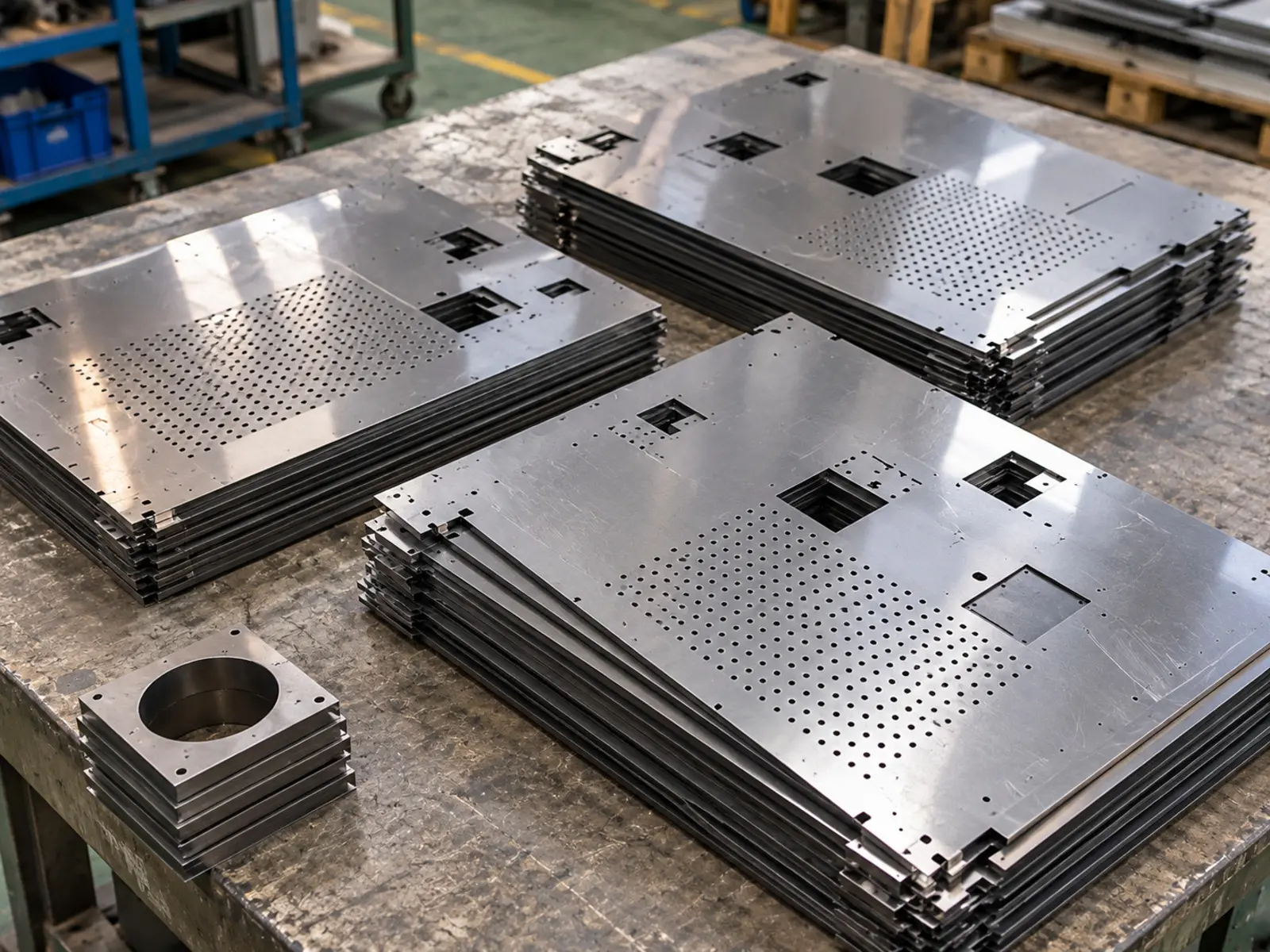
Flat brackets and plates with holes, slots and cut-outs are cut straight from sheet, ready to use or to bend.
Flat patterns for boxes, covers and rack chassis are cut first, then folded on the press brake.
Patterns of slots and holes for airflow or speaker grilles are cut without a punching die.
Thin shims, washers and spacers in steel, stainless or brass are cut to exact outlines in any quantity.
Plates with cut-out logos or lettering are cut cleanly, then brushed, anodized or powder-coated.
Early versions of stamped parts are laser cut first, so the design can be tested before paying for a die.
Source: Dayao factory data (2026) — sheet metal workshop with laser cutting; common laser-cutting applications.
Maximum thickness depends on laser power and the metal. As a reference from TRUMPF fiber laser data, a 3 kW laser cuts up to about 20 mm of mild steel and 15 mm of stainless steel or aluminum, while a 12 kW laser reaches about 30 mm of mild steel and 40 mm of stainless steel. Copper and brass reflect the beam, so their limits are lower. Good edge quality needs some margin below the maximum.
| Fiber laser power | Mild steel | Stainless steel | Aluminum | Copper | Brass |
|---|---|---|---|---|---|
| 3 kW | 20 mm | 15 mm | 15 mm | 6 mm | 6 mm |
| 4 kW | 25 mm | 20 mm | 20 mm | 8 mm | 8 mm |
| 6 kW | 25 mm | 25 mm | 25 mm | 10 mm | 10 mm |
| 8 kW | 25 mm | 30 mm | 25 mm | 12.7 mm | 10 mm |
| 10 kW | 30 mm | 40 mm | 30 mm | 12.7 mm | 12.7 mm |
| 12 kW | 30 mm | 40 mm | 30 mm | 12.7 mm | 12.7 mm |
At Dayao: laser power and bed size are being confirmed 激光功率 kW / 幅面 mm / 激光类型. Use the planner at the top of the page to check a material and thickness, then send the file for confirmation.
Source: TRUMPF “TruLaser Series 1000” flyer — maximum sheet thickness by laser power (standard values, without the thick-sheet cutting package).
Laser cutting typically holds about ±0.1 mm on sheet up to 3 mm thick, ±0.1–0.3 mm on 3–12 mm sheet and ±0.4–0.8 mm on thicker plate, because the kerf, the heat-affected zone and edge taper all grow with thickness. ISO 9013 grades the cut edge itself. Features that need tighter tolerances, such as bearing bores, are machined after the blank is cut.
| Feature or thickness | Typical result | What it means for your drawing |
|---|---|---|
| Thin sheet, up to about 3 mm | About ±0.1 mm on hole-to-hole and edge-to-hole sizes | Narrow kerf and little heat; the most accurate laser work |
| Medium sheet, 3–12 mm | About ±0.1–0.3 mm | Kerf and the heat-affected zone widen; the cut edge starts to taper |
| Thick plate, over 12 mm | About ±0.4–0.8 mm | Taper and edge roughness grow; machine critical features after cutting |
| Kerf (width of the cut) | About 0.1–0.4 mm, depending on thickness | The program offsets the path by half the kerf, so you draw the finished size |
| Cut-edge quality (ISO 9013) | Graded by squareness of the edge (u) and roughness (Rz5), plus a size tolerance class | Write the ISO 9013 grade on the drawing if the edge itself matters |
| Features that need more | Bearing bores, reamed holes, ±0.01 mm sizes | Laser-cut the blank, then CNC machine those features |
Tolerances across bends and on formed parts are covered in the sheet metal tolerances section.
Source: ISO 9013:2017; typical published laser-cutting tolerances and kerf widths (2025–2026). Values are industry ranges, not Dayao guarantees.
The assist gas decides what the cut edge looks like. Nitrogen gives a clean, oxide-free edge that paints and welds without cleaning, and is the usual choice for stainless steel. Oxygen cuts thick mild steel efficiently but leaves an oxidized edge that normally needs cleaning before powder coating. Compressed air is the cheapest and suits aluminum and thin mild steel.
| Assist gas | Used for | Edge result | Effect on coating, welding and cost |
|---|---|---|---|
| Nitrogen | Stainless steel, and mild steel up to about 6 mm | Clean, bright, oxide-free edge; on stainless, gas purity sets the edge quality | Paints, powder-coats and welds without edge cleaning; higher gas cost |
| Oxygen | Mild steel of any thickness the laser can cut | Oxidized dark edge; the burning reaction helps cut thick plate | Edge oxide normally needs cleaning before powder coating; slower than nitrogen on thin sheet |
| Compressed air | Aluminum, and thin mild steel (about 3 mm at 3 kW, 6 mm at 6 kW and up) | Fast with little burr on aluminum; darker edge on stainless | Lowest cost; the oxygen in air can affect some powder coatings |
Tell us the finish. If the part will be powder-coated or welded, say so in the quote request, so the gas can be chosen for a coating-ready edge.
Source: Fabricating & Metalworking, “The Role of Assist Gases in Laser-Cutting Applications” (2022).
Laser cutting is the best fit for metal sheet up to medium plate when you need small holes, sharp detail and tight tolerances. Waterjet cutting suits non-metals, very thick plate and parts that must not be heated. Plasma cutting is fastest on thick conductive plate where precision matters less. For high volumes of the same flat part, stamping can beat all three once a die is paid for.
| Method | Materials and thickness | Kerf and accuracy | Heat effect | Best for |
|---|---|---|---|---|
| Laser cutting | Metal sheet from thin foil to medium plate | Narrow (about 0.1–0.4 mm) and accurate | Small heat-affected zone along the edge | Brackets, panels, enclosure blanks, small precise holes and slots |
| Waterjet cutting | Almost any material: metal, stone, glass, plastics, composites, very thick plate | Wider; slight taper on thick parts | No heat, so no heat-affected zone or hardening | Heat-sensitive parts, non-metals and very thick plate |
| Plasma cutting | Electrically conductive metals, mostly thick plate | Widest; edges often beveled | Larger heat-affected zone and more dross | Thick structural parts where speed matters more than precision |
When does a stamping die pay off instead? See laser cutting vs stamping. Whether Dayao also offers waterjet or plasma cutting is being confirmed 是否有水切割 / 等离子?.
Source: common comparison of thermal and non-thermal cutting processes; ISO 9013:2017 (thermal cuts).
A laser-ready DXF is drawn at 1:1 in millimetres, has every contour closed with no duplicate lines, holds one named part per file, keeps engraving and bend lines on their own layers, and has text turned into outlines. If the blank will be bent, send the STEP model as well, so the flat pattern is made with the right bend allowance.
Export the DXF at full size in mm, with no title block, borders or dimensions inside the cutting area.
Each outline and hole must be one closed shape with no gaps or overlapping duplicate lines, or the machine may cut twice or stop.
Put one part in each DXF, or label each part with a name and quantity so nesting and counting are correct.
Lines to be marked or engraved, and bend lines, go on separate layers so they are not cut through by mistake.
Convert text and logos to closed outlines. Very small text and inside corners need to be larger than the kerf to survive cutting.
If the blank will be bent later, send the STEP model too; the flat pattern is then made with the right bend allowance.
The full list of files and details to send with any quote is on the quote page.
Source: common CAD and nesting practice for laser cutting; Dayao engineering practice (2026).
Most laser-cut parts need one or more steps after cutting: deburring so edges are safe, tapping or countersinking because a laser only cuts straight walls, bending and welding into enclosures, CNC machining for tight features, surface finishing, and marking. Dayao does these steps in the same factory, so a laser-cut blank becomes a finished part without changing suppliers.
Laser-cut edges are deburred by hand or by machine so they are safe to handle and ready to coat.
Holes are tapped or countersunk after cutting, because a laser cuts straight walls only.
Blanks become enclosures and brackets on the press brake; inserts are pressed in.
Critical bores, threads and tight-tolerance faces are machined into the laser-cut blank.
Parts are powder-coated, anodized, plated, brushed or passivated after cutting and deburring.
Logos, part numbers and serials can be marked on the part instead of using a sticker.
Source: Dayao factory data (2026): laser cutting, bending, welding, stamping, hardware insertion, CNC machining and finishing in one factory.
At Dayao, a laser cutting job runs in six steps: an engineer reviews the file and drawing, parts are nested on the sheet to save material, a first piece is approved for new parts, cutting runs with in-process checks, parts are deburred and inspected, and they move on to bending, machining or finishing, or are packed and shipped. There is no minimum order.
A Dayao engineer checks the DXF or STEP file, the thickness, material and tolerances, and asks about anything unclear.
Parts are nested on the sheet to use as much of it as possible, which lowers the material cost per part.
For new parts, a first piece is cut and measured, and you approve it before the batch is cut.
In-process checks (IPQC) measure parts from the sheet during the run, so drift is caught early.
Parts are deburred, then sizes, flatness and edges are checked at outgoing inspection before the next process.
Parts go on to bending, welding, machining or finishing, or are packed and shipped on FOB, EXW, CIF or DDP terms.
Source: Dayao factory data (2026): IQC / IPQC / OQC, sample approval before batches, no minimum order, Incoterms® 2020 shipping terms.
Buyers most often ask how thick a metal a laser can cut, how accurate laser cutting is, which files to send, which metals can be cut, and whether laser cutting or stamping is cheaper. In short: thickness depends on laser power, thin sheet holds about ±0.1 mm, a 1:1 DXF in millimetres is the standard file, and laser wins until volume justifies a die.
A laser cutting service cuts flat parts from metal sheet with a focused laser beam that follows your CAD file. It needs no cutting die, so prototypes and small batches are affordable, and it cuts holes, slots and outlines to about ±0.1 mm on thin sheet.
It depends on the laser power and the metal. As a reference, a 6 kW fiber laser cuts up to about 25 mm of mild steel, stainless steel or aluminum, and about 10 mm of copper or brass. Dayao’s laser power is being confirmed. 激光功率 / 最大厚度待补
Laser cutting typically holds about ±0.1 mm on sheet up to 3 mm, ±0.1–0.3 mm on 3–12 mm, and ±0.4–0.8 mm on thick plate. Features that need tighter tolerances are machined after cutting.
A DXF at 1:1 scale in millimetres for each flat part, or a STEP model if the part will be bent, plus the material, thickness, finish and quantity. A PDF drawing is needed for tolerances.
Mild steel, galvanized steel, stainless steel, aluminum, copper and brass can be laser cut. Reflective metals such as copper and brass are cut on fiber lasers.
No. Laser cutting needs no tooling, so a single prototype is fine. The price per part falls with quantity, because parts share the sheet and the setup.
The maximum sheet size depends on the laser bed and is being confirmed. 激光切割幅面待补 Common bed sizes are 3000 × 1500 mm and 4000 × 2000 mm.
Tube and profile laser cutting needs a dedicated tube laser. Whether Dayao runs one is being confirmed. 是否有激光切管机?
Laser cutting is cheaper for prototypes and small to medium batches because it needs no die. Stamping becomes cheaper at high volume once the die cost is shared. The sheet metal page compares the switch point.
Yes. Dayao can sign a non-disclosure agreement before you share DXF files, models or drawings. Tick the NDA box in the quote form or ask by email.
Reviewed by the Dayao engineering team · Updated October 2026
Send a 1:1 DXF in millimetres, or a STEP model if the part will be bent, with the material, thickness, finish and quantity. A Dayao engineer checks the file, nests it on the sheet and replies with an itemized quote that can include bending, welding and finishing. There is no minimum order, and an NDA can be signed first.